


AI platforms are shipping major capability updates every week. Your brain needs 66 days to form a new habit. Here's the framework that closes the gap, and the four traits that separate those who compound advantages from those who fall behind.
“Which AI tool should I learn?”
Wrong question.
You finally figure out a workflow. It clicks. You feel competent for maybe 72 hours. Then the notification drops: “What’s New in [insert platform].” And the tool you just learned? It’s different now. The feature you mastered got replaced, merged, or buried under three new ones you’ve never seen.
So you start over. Again.
This keeps happening because we’ve been framing the problem wrong. The question was never “which tool.” The tool doesn’t matter. By the time you’ve built muscle memory around it, the platform has shipped two updates that changed how it works. The real question is: how do you build the capacity to adapt continuously when the tools never stop changing?
That’s what this piece answers.
The Practitioner’s View
I manage technology across 120+ franchise locations, 2,500+ employees, in 20+ states. When I say “iteration fatigue,” I’m not pulling from a whitepaper. I’m watching it happen in real time across a distributed workforce where “one more thing to learn” hits different when you’re already running at capacity.
So I went looking for the data to confirm what I was seeing on the ground. What I found was worse than I expected.
Between November 17 and December 11, 2025, four frontier AI companies released flagship models in a 24-day window. Grok 4.1, Gemini 3, Claude Opus 4.5, GPT-5.2. Boom, boom, boom, boom. In early 2026, OpenAI shipped GPT-5.3 and GPT-5.4 two days apart, with no public explanation. METR’s research shows AI capability doubling times have compressed from roughly 7 months to under 3 months when you isolate the most recent models. Epoch AI identified a structural breakpoint around April 2024 where the rate of frontier improvement nearly doubled.
Mary Meeker used the word “unprecedented” on 51 pages of a 340-page report. Fifty-one times. When Mary Meeker runs out of adjectives, pay attention.
What You’ll Walk Away With
We’re covering five things:
See the acceleration quantified. Actual data on how fast AI platforms are iterating and why it feels like drinking from a fire hose.
Understand why your brain fights it. The behavioral science behind change resistance (it’s not a character flaw, it’s biology).
Learn the 66-Day Problem. The structural mismatch between habit formation and AI release cadences that nobody is talking about.
Get the A.L.I.C. framework. Four traits that separate those who compound advantages from those who fall behind, with clear ownership: two on employees, two on leadership.
Walk away with a starting point. What to do this week, not this quarter.
The Big Reframe
The competitive moat is no longer what you know. It’s how fast you can learn, unlearn, and relearn.
That sentence deserves a second read. Because everything most organizations are doing right now is built on the opposite assumption:
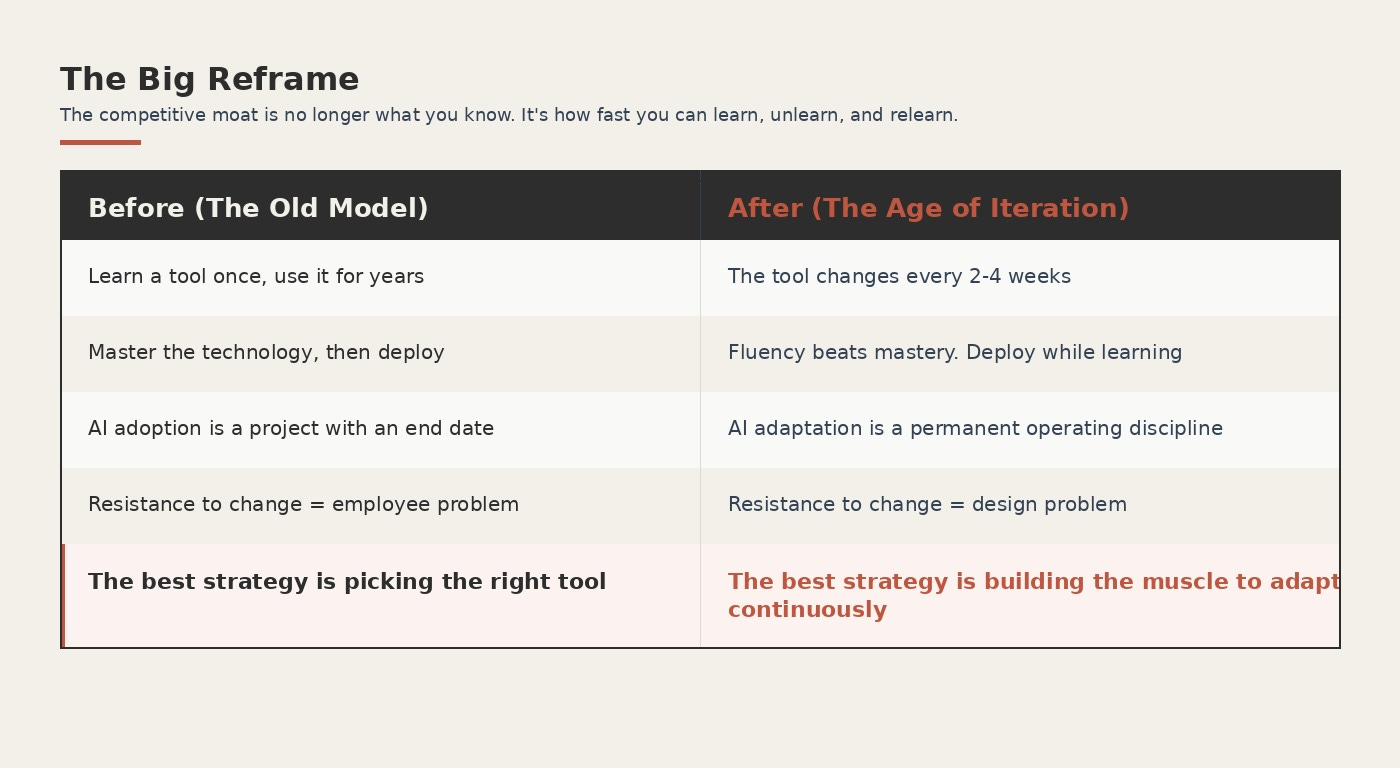
Read that last row again. If your strategy is “pick the right tool,” you’ve already lost the thread. The right tool today is the wrong tool in six weeks. The muscle to adapt continuously is the only durable advantage.
And that muscle has a name.
A.L.I.C.: The Four Survival Traits
Four traits. Two owned by employees. Two owned by leadership. All four non-negotiable.
1. Adaptability (Employee-Owned)
The willingness to adjust your behavior, workflows, and mental models without waiting for permission. Not a personality trait. A strategic competency. The World Economic Forum ranks resilience and adaptability as the #2 most important skill globally, right behind analytical thinking (which 70% of employers call essential). Gallup’s 2025 data shows teams with high adaptability are 36% more productive and 32% more engaged.
The employee who treats each platform iteration as a compounding advantage (not a disruption) becomes irreplaceable. The one who waits for the dust to settle? The dust isn’t settling.
2. Learning (Leadership-Owned)
The organizational commitment to build continuous learning infrastructure. Not a quarterly training event. A weekly operating rhythm. 39% of existing worker skills will transform or become outdated by 2030, according to the WEF. Organizations that focus on cultural change see 5.3x better transformation outcomes than those focused on technology alone (McKinsey).
The critical insight most leaders miss: people follow what you do with AI, not what you say about it. If leadership isn’t visibly learning and adapting, nobody else will either. You go first.
3. Ideation (Employee-Owned)
The capacity for original, associational thinking. Connecting unrelated concepts in ways AI cannot. Wharton research found something fascinating: AI improves the quality of individual ideas but reduces the diversity of ideas across groups. It makes us individually better but collectively more similar.
That’s the trap. And it’s also the opportunity. The employee who brings novel combinations of experience, domain knowledge, and pattern recognition to AI-assisted workflows creates value that no model can replicate. AI can’t do your lived experience. It can’t improvise. It can’t add a knowledge domain on the fly because something reminded it of a conversation from three years ago. Feed that advantage. Read outside your lane. Talk to people who think nothing like you.
4. Change (Leadership-Owned)
The organizational capability to manage continuous change without burning out the workforce. Seventy percent of transformations fail. Not 30%. Not half. Seventy percent (McKinsey, Gartner, Bain all confirm this range). And the vast majority fail on culture, not technology.
Only 42% of burned-out employees tell their manager. Among those who do, 42% say their manager takes no action. That means the signal is invisible AND the response system is broken. In the Age of Iteration, change management isn’t a project phase. It’s a permanent operating discipline, owned by leadership, measured like any other business function.
The 66-Day Problem
Now here’s why A.L.I.C. isn’t optional.
University College London’s habit formation research (Lally et al.) found it takes a median of 66 days to build automaticity around a new behavior. Range: 18 to 254 days. Complex behavioral changes, like adopting new AI workflows, fall at the upper end of that range.
AI platforms ship major updates every 2 to 4 weeks. Four flagship models in 24 days. Two GPT versions two days apart. Capability doubling time under 3 months and compressing.
Your brain needs 66 days. The platform ships every 14. That’s the whole problem.
You’re being asked to adapt to the next iteration before you’ve automated the previous one. You’re perpetually in the learning curve. The question isn’t whether that’s uncomfortable. It is. The question is whether you treat that discomfort as a sign you’re behind or as the price of staying ahead.
The burnout data confirms the toll. Employee burnout hit 66% in 2025 (Modern Health/Forbes). Deloitte’s 2025 Workforce Intelligence Report identifies cognitive strain, not workload volume, as the #1 burnout driver for the first time. Gen Z burnout: 66%. Millennials: 58%. Boomers: 37%. The people most expected to adopt AI are burning out fastest.
This isn’t sustainable without a framework. That’s what A.L.I.C. is for.
What to Do This Week
For Individuals (the employee side of A.L.I.C.):
Shift from mastery to fluency. You don’t need to learn every feature. You need to recognize when a new capability matters for YOUR work and integrate the pieces that create value. Stop trying to “complete” a tool. There is no complete.
Build a 15-minute weekly learning sprint. Pick the AI tool you use most. Open the changelog or “What’s New” section every Monday. Spend 15 minutes exploring one new capability. That’s it. Small, consistent exposure beats quarterly deep dives every time.
Invest in your ideation edge. Read outside your domain. Have conversations with people who solve different problems than you do. Your weird combination of experience, industry knowledge, and pattern recognition is the one thing AI can’t replicate. Feed that.
Accept productive discomfort as the new normal. The period where the old way is faster than the new way is temporary. Your brain overweights that period (behavioral economists call this hyperbolic discounting). Push through it. The payoff compounds.
For Leaders (the leadership side of A.L.I.C.):
Build iteration reviews into the operating rhythm. Monthly “what changed in our AI tools” sessions. Not IT-led. Leadership-led. You go first. When your team sees you learning in real time, it normalizes the discomfort.
Communicate the “why” behind every workflow change. McKinsey’s #1 transformation failure mode: no compelling “why.” Your people can absorb change if they understand why it matters. Release notes aren’t enough. Context is everything.
Monitor change fatigue proactively. Only 42% of burned-out employees tell their manager. Don’t wait for the signal. Ask. Check in. Build it into your 1-on-1s.
Designate an “iteration scout.” Someone on the team whose job includes tracking platform updates and translating them into practical workflow implications. Not an IT role. A bridge role. The person who reads the changelog so 50 other people don’t have to, and tells the team what actually matters for their work.
What A.L.I.C. Doesn’t Solve
It doesn’t eliminate the discomfort. Building adaptation muscles doesn’t make change painless. It makes the pain productive instead of paralyzing. If you’re looking for a framework that makes the acceleration disappear, this isn’t it. The acceleration isn’t disappearing.
It’s not a silver bullet for broken culture. If your organization has toxic leadership, zero trust, or no psychological safety, A.L.I.C. won’t fix that. The framework assumes a baseline of functional organizational health.
The speed vs. quality tension is real. 2025 was the year of AI speed. 2026 is expected to be the year of AI quality. Not every update deserves your attention. Chasing every release is a recipe for exactly the burnout the framework is designed to prevent. Be selective.
Individual adaptation has a ceiling without organizational support. An employee can build all the Adaptability and Ideation in the world. But if leadership doesn’t invest in Learning infrastructure and Change management, the individual burns out alone. The framework requires both sides of the contract.
If You Only Remember Three Things
The acceleration is real and it’s not slowing down. AI capability doubling times have compressed from 7 months to under 3 months. Platforms are shipping major updates weekly. This is the operating environment now.
The gap isn’t between you and the technology. It’s between how fast the technology iterates and how fast humans adapt. That’s a design problem, not a willpower problem. 66 days vs. 14 days. The math doesn’t work unless you change the approach.
A.L.I.C.: Adaptability, Learning, Ideation, Change. Two on employees. Two on leadership. Both sides show up, or neither side wins. Build the muscles. The iteration isn’t stopping. But it can become your advantage.
Good Luck - Dan