


Anthropic’s Cowork plugins wiped $1 trillion off software stocks. Both Anthropic and OpenAI dropped new models on the same day. They’re running dueling Super Bowl ads. Here’s the 8-minute version of what actually matters, and the one move you should make this week.
This Week in 30 Seconds
Forget “which AI model is winning?” Wrong question.
Both platforms are now capable enough that the bottleneck isn’t the AI. It’s whether you’ve redesigned your workflows to use it. The race between models is over. The race between you and your competitors just started.
I spent the week reading earnings calls, scanning 15+ sources, testing Cowork plugins, and watching $1 trillion evaporate from software stocks, so you get the version that matters to your business in 8 minutes.
Five stories this week. For each one: the news (what happened), the noise (what everyone’s saying), and the signal (what actually matters).
Before You Read: The Shift That Happened This Week
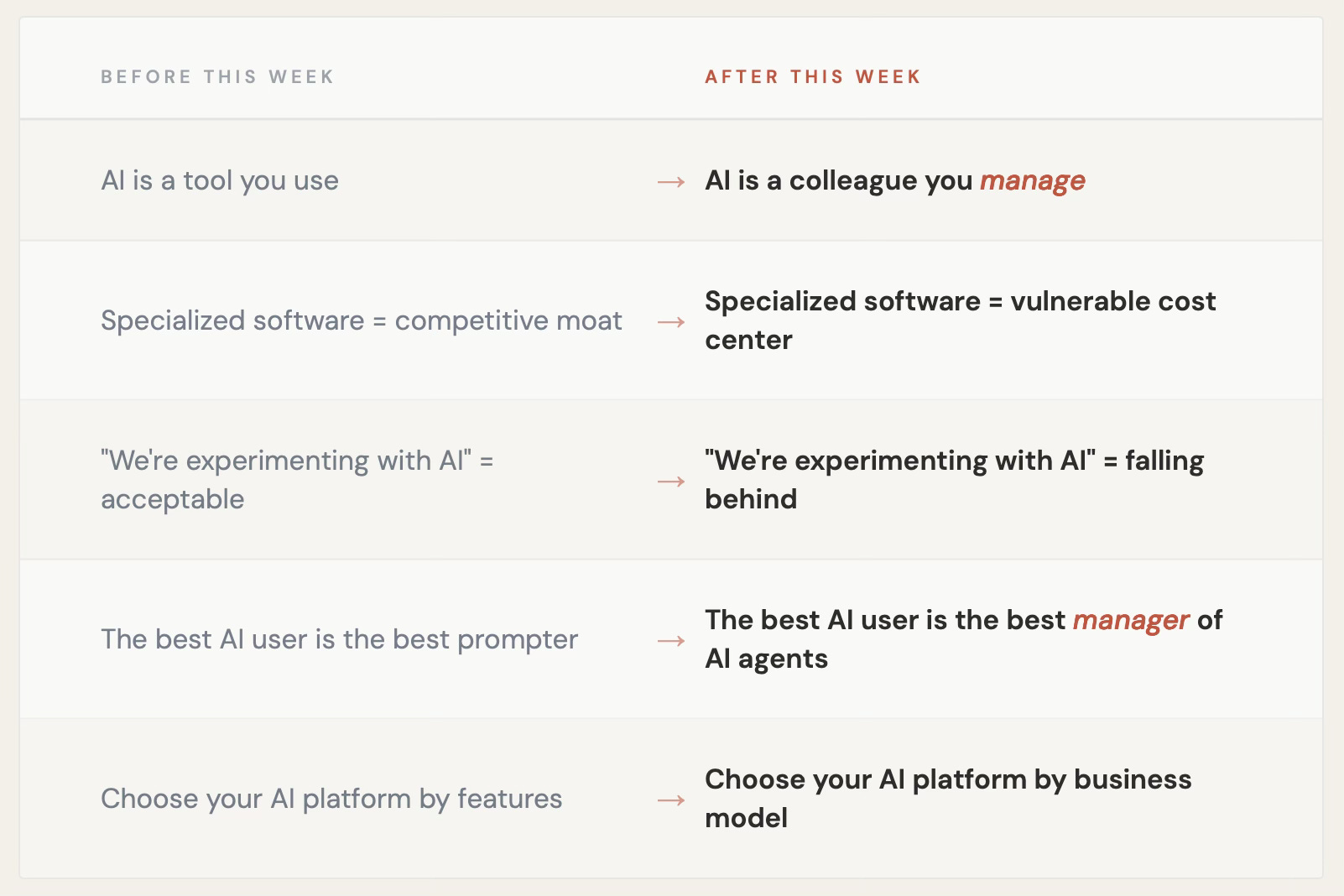
The shift from “AI as a tool you use” to “AI as a colleague you manage” happened this week. Most operators haven’t noticed yet.
Story 1: The SaaSpocalypse Is Your Leverage Moment
The News: On January 30, Anthropic released 11 open-source plugins for Claude Cowork targeting legal, finance, sales, and marketing workflows. By Tuesday, Thomson Reuters dropped 15.8%. LegalZoom sank 19.7%. The S&P 500 software index shed roughly $1 trillion in market value in a single week. HubSpot is down 39% for the year. Figma 40%. Atlassian 35%.
The Noise: Wall Street is panic-selling on a narrative. “SaaSpocalypse” is the buzzword. Every analyst is picking winners and losers.
The Signal: A $200/month AI tool started doing tasks that companies currently pay $50K to $500K per year for in specialized software licenses. That’s available right now. The enterprise software companies are the ones getting hammered, but the disruption hits SMBs differently. You’re not losing stock value. You’re gaining leverage. The same tools threatening Thomson Reuters’ market cap put enterprise-grade capabilities in the hands of a 10-person firm. But leverage only works if you pick it up.
Your Move: Pick one specialized software tool you’re paying for (or wish you could afford). Spend 30 minutes this week testing whether an AI assistant can handle 60% of that workflow. Not perfectly. Just competently enough to change the math.
Story 2: “Vibe Working” Just Entered the Lexicon
The News: On the same day (February 5), Anthropic dropped Claude Opus 4.6 and OpenAI released GPT-5.3-Codex. Opus features a 1 million token context window (5x larger than its predecessor), “agent teams” that coordinate multiple AI workers in parallel, and PowerPoint integration. OpenAI’s model is their “first model that was instrumental in creating itself.” Anthropic’s head of enterprise product coined the term “vibe working.”
The Noise: Tech media is treating this as a horse race. Benchmark comparisons. Speed tests. Who’s winning?
The Signal: “Vibe working” is the non-technical equivalent of “vibe coding.” Describe the outcome, AI handles execution. The 1M token context window means Claude can hold your entire project in memory (every document, every conversation, every constraint) and work across all of it simultaneously. That’s not a chatbot. That’s a junior analyst who never sleeps. And GPT-5.3-Codex literally helped build itself. I’ll be honest, I’m still sitting with that one. The pace of improvement is about to compound in ways none of us have fully thought through.
Your Move: Block one hour this week to test a real project (not a demo, an actual deliverable) with the latest models. Feed it a complete project brief. The gap between what you think AI can do and what it actually does right now is probably wider than you realize.
Story 3: The Super Bowl Ad War Is Actually a Business Model Decision
The News: Anthropic is running a Super Bowl ad mocking OpenAI for testing ads in ChatGPT. Tagline: “Ads are coming to AI. But not to Claude. Keep Thinking.” They also published a manifesto called “Claude is a space to think,” declaring ads incompatible with a helpful AI assistant. Sam Altman fired back on X, calling the ad “deceptive” and claiming more Texans use ChatGPT for free than use Claude in the entire U.S.
The Noise: Tech Twitter is treating this like a celebrity feud. Memes. Hot takes. Entertainment value is high, substance is low.
The Signal: When your AI assistant is ad-supported, the incentives shift. The tool stops working purely for you and starts working partly for advertisers. Same dynamic that turned social media from a communication tool into an attention-harvesting machine. Anthropic compared Claude to “a notebook or a clean chalkboard.” That’s deliberate positioning as a thinking tool, not a consumer product. For operators building real workflows on AI, that distinction matters more than any benchmark score.
Your Move: You don’t need to switch platforms today. But know why your primary AI platform makes money. That determines whose problem it’s solving, yours or an advertiser’s.
Story 4: Experimentation Without Accountability Is Just Waste
The News: A Forbes piece by Janet Lam argues that companies still treating AI as a “side initiative” in 2026 will face tool overload, unclear ROI, and internal frustration. The core thesis: AI isn’t separate from business strategy. It IS business strategy.
The Noise: The “experimentation to execution” framing is everywhere. Every consulting firm has a version of this article.
The Signal: The gap between companies who’ve internalized this and companies who haven’t is about to become visible, and painful. The organizations pulling ahead aren’t the ones with the most AI tools. They’re the ones where a specific person owns a specific outcome, and AI is measured by whether that outcome improves. Sales cycle reduction. Customer response time. Contract review throughput. Real numbers, attached to real people. More AI tools don’t fix unclear goals. They amplify them.
Your Move: Pick one business outcome. Assign one person. Give them 30 days to use AI to move the number. No committees. No “AI strategy” documents. Just a person, an outcome, and a deadline.
Story 5: Your Next Hire Might Be an AI Agent Owner
The News: Writer’s Chief People Officer published a framework arguing the agentic AI revolution creates entirely new roles. The stat: 92 million jobs may be displaced by 2030, but 170 million new roles will be created. Productivity gains of up to 30% with proper AI agent management.
The Noise: The “new AI roles” conversation has been going for a year. Most of it is vague and aimed at Fortune 500 companies.
The Signal: The most valuable professional skill of 2026 isn’t prompt engineering. It’s managing AI agents the way a manager manages people. Setting goals. Defining constraints. Reviewing output. Knowing when to intervene and when to let it run. This is the shift from the “tool user” era to the “orchestrator” era. For SMBs, you don’t need to create a new job title. The person on your team who’s already doing this work informally? Give them the title. Or at least the time.
Your Move: Identify your team’s strongest AI user. Give them 20% of their time to experiment with AI agents, define success metrics, and report back in 30 days. You’re not creating a new position. You’re recognizing a capability that already exists.
The Numbers That Matter
Market Impact
$1 trillion in software market value wiped in one week (Reuters)
WisdomTree Cloud Computing Fund down ~20% YTD (CNBC)
Thomson Reuters’ worst single-day drop on record: 15.83% (VentureBeat)
Model Capabilities
Opus 4.6 context window: 1 million tokens, up from 200K (Anthropic)
Enterprise customers make up ~80% of Anthropic’s business (CNBC)
GPT-5.3-Codex: “first model instrumental in creating itself” (OpenAI)
The Workforce Shift
92 million jobs displaced by 2030; 170 million new roles created (Writer.com)
Productivity gains of up to 30% with proper AI agent management (Writer.com)
What To Do Based on Your Role
If you run operations: Audit your software stack. Identify the two most expensive specialized tools. Test whether an AI assistant handles 60% of those workflows at a fraction of the cost.
If you run sales or marketing: The marketing automation tools getting hammered in the market are getting hammered because AI can do much of what they do. Test one campaign workflow this week. “Vibe working” means describing the outcome and letting AI handle execution. Try it on your next proposal.
If you handle finance or legal: This is where Cowork’s plugins hit hardest. Contract review, compliance tracking, financial analysis. Test one task this week. Not to replace your judgment. To replace the hours of manual prep before your judgment kicks in.
If you’re thinking about hiring: Before posting that next role, ask: “Could 20% of this role be handled by an AI agent?” If yes, you might need a different kind of hire. Someone who can orchestrate AI, not just do the work manually.
Try This Prompt
Take everything in this briefing and apply it to your specific business.
For ChatGPT / Claude:
I run a [YOUR COMPANY SIZE]-person [YOUR INDUSTRY] firm. I need you to act as a strategic operations advisor helping me respond to this week's shifts in AI.

Here's the context you need:
- AI tools like Claude Cowork and ChatGPT can now handle legal, finance, marketing, and sales workflows that previously required $50K–$500K/year in specialized software licenses
- AI context windows now hold 1M tokens — enough to process an entire project's documents, conversations, and constraints simultaneously
- AI models are coordinating teams of agents that work in parallel on complex tasks
- The shift from "AI as a tool I use" to "AI as an operational colleague I manage" is accelerating across industries

Our current software stack includes: [LIST YOUR 3-5 MOST EXPENSIVE OR TIME-CONSUMING TOOLS]
Our biggest operational bottleneck right now is: [DESCRIBE IN 1-2 SENTENCES]

Based on this, give me:
1. Which 2-3 specialized software tools or manual workflows I should test replacing (or augmenting) with AI this quarter — rank by estimated ROI and ease of testing
2. What role or responsibility should be formalized as our "AI operations" function — who on a team like mine is the right person, and what does 20% of their time on this look like?
3. A 30-day pilot structure: what specifically to test in week 1 vs. week 4, who owns each test, and how to measure success with concrete metrics
4. The single highest-ROI workflow I should test first — walk me through exactly how to set up that test this week

Be specific to my industry. Prioritize quick wins that build confidence and create internal momentum. Flag anything where I'd need to keep a human in the loop for quality or compliance reasons.
For Perplexity:
What are the most cost-effective AI alternatives to expensive specialized business software (legal research, financial analysis, marketing automation) for small and mid-size companies in 2026? Include real examples of SMBs replacing enterprise tools with Claude Cowork or ChatGPT, estimated cost savings, and practical limitations.The Contrarian Corner
The “SaaSpocalypse” coverage is framed as big companies losing value. The real story is small companies gaining power. Every dollar that comes off Thomson Reuters’ market cap represents capability that’s becoming democratized. The stock market is panicking because software monopolies are being dismantled. If you’re a 20-person firm that could never afford LexisNexis, this is your moment, not theirs.
And the model war? Covered like a horse race. The race doesn’t matter to operators. What matters is that both platforms are now capable enough that the bottleneck is you, not the AI. (I include myself in that, by the way. I tested three Cowork plugins this week and realized I’ve been underusing tools I already pay for.)
If You Only Remember 3 Things
The SaaSpocalypse is your leverage. The same tools crashing enterprise software stocks put enterprise-grade capabilities in your hands at $200/month. Pick one workflow and test it this week.
The most valuable skill in AI just changed. Not prompting. Managing AI agents the way you manage people. Setting goals, reviewing output, knowing when to step in. Start thinking of yourself as an orchestrator, not a user.
Your AI platform’s business model matters more than its benchmarks. Know whether your AI is working for you or for an advertiser. That choice compounds quietly. Give it two years and it won’t be quiet anymore.
Your One Move This Week
Pick one workflow that currently requires specialized software or manual effort. Test whether an AI tool can handle 60% of it. Not perfectly. Just competently enough to change the math.
One workflow. One test. One week.
If the result surprises you (and based on what dropped this week, it probably will), you’ll have your answer on where to focus next. And if it doesn’t surprise you, you’ve still ruled something out. Either way, you’re further ahead than last Monday.
If you found this useful, forward it to the person on your team who should be your AI operations lead. They probably already know who they are.
Good Luck - Dan