

This Week in 30 Seconds
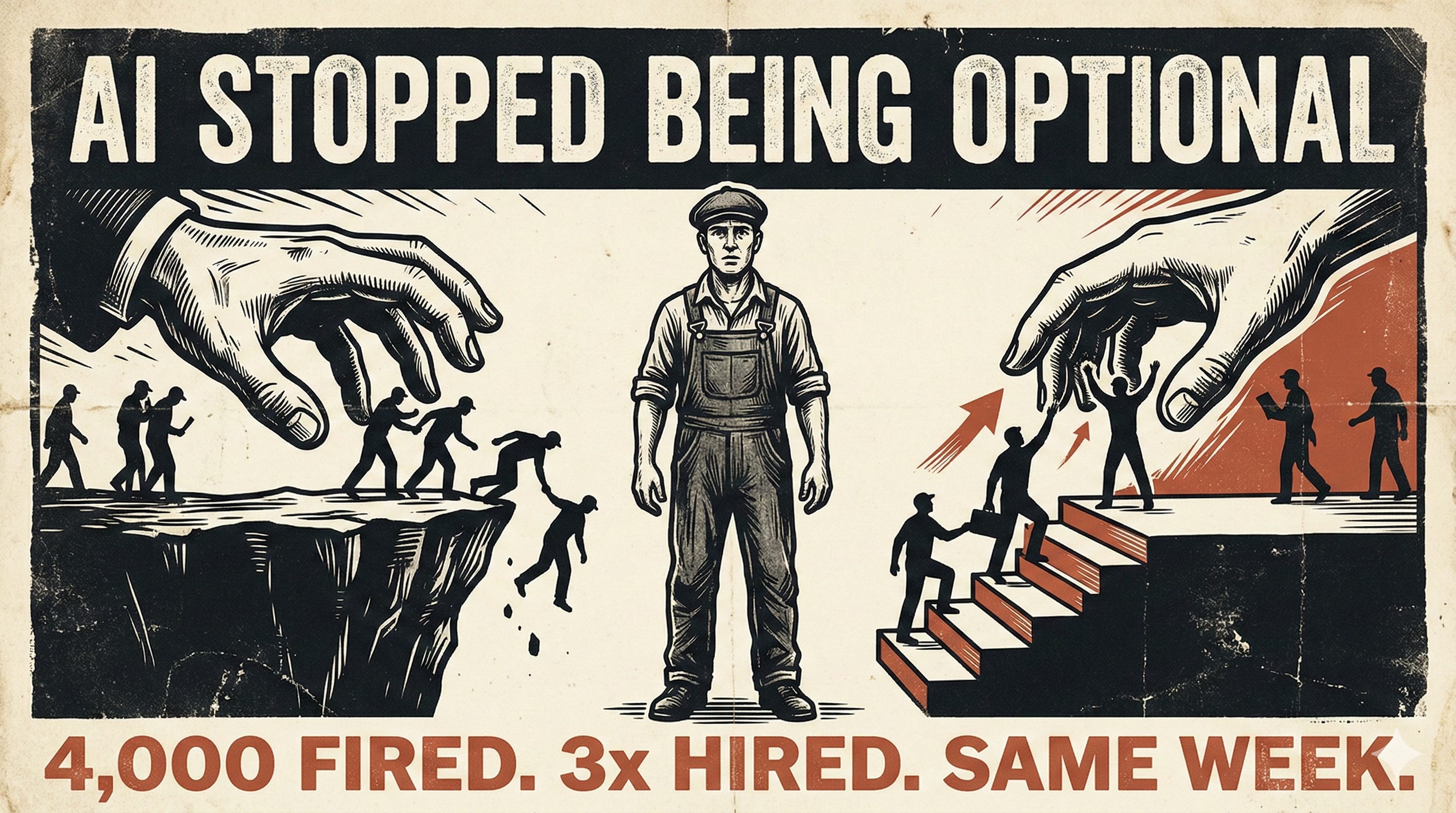
Block fired 4,000 people and said AI did it. Wall Street gave them a 24% raise. Google, Meta, and Accenture are now tracking whether employees use AI and tying it to promotions. The Dallas Fed published wage data showing AI is already splitting the labor market along experience lines. And IBM is tripling junior hiring while everyone else cuts. The AI conversation just shifted from “which tools should we buy?” to “who stays, who goes, and what does the team look like in three years?”
Four stories this week. For each one: the news (what happened), the noise (what everyone’s saying), and the signal (what actually matters for you).
Story 1: Block Fires 4,000 People, Blames AI, and Wall Street Loves It
The News: Jack Dorsey’s Block (Square, Cash App, Afterpay) laid off more than 4,000 employees, roughly 40% of its workforce. Dorsey told shareholders that “intelligence tools have changed what it means to build and run a company.” CFO Amrita Ahuja put it more bluntly: they see an opportunity to “move faster with smaller, highly talented teams using AI to automate more work.” The stock jumped 24%. Block’s Q4 was actually strong ($6.25 billion in revenue, gross profit up 24% year-over-year). This wasn’t a struggling company trimming fat. It was a healthy company making a bet.
The Noise: The AI skeptics see a PR-wrapped mass firing. The AI boosters see the vanguard of a leaner future. Tech media defaults to “is AI coming for YOUR job?” Nobody’s talking about the messy middle.
The Signal: Forbes analyst Ron Shevlin called it clearly: Block inflated its headcount by 160% during the pandemic easy-money era (from ~3,800 in 2019 to over 10,000 by 2025). They’d already cut hundreds in early February. The AI framing is convenient, and it’s great for the stock price. Bloomberg is reporting suspicions of “AI washing,” using AI as a narrative cover for restructuring driven by other pressures.
Two things to watch. First, Block is a financial services company. They handle payments, lending, fraud detection, KYC compliance, regulatory reporting. These are functions where mistakes have legal consequences. Cutting 40% of the workforce while betting on “intelligence tools” for compliance is a massive, untested gamble. Second, Klarna’s CEO made the same claim last year (AI helped shrink workforce by 40%), then Klarna had to rehire workers because the AI couldn’t handle the work. That cautionary tale has a shelf life of about 12 months before we find out if Block follows the same path.
For SMB operators, the Block story is really about what’s coming for you. Every company is about to be asked whether they’re “using AI to be more efficient.” You need an answer that’s more honest than Dorsey’s. And honestly, that conversation is uncomfortable. Nobody wants to map out which tasks on their team could be automated. It feels like building a case against the people you work with every day. But that’s not what it is. The operators who navigate this well can articulate exactly which tasks AI handles, which tasks still need humans, and why their team is the right size for the work. That clarity protects your people more than avoiding the question does.
Your Move: Run a task audit this week. For every role on your team, identify which tasks AI could realistically handle today, which need human judgment, and which fall somewhere in between. Not to justify cuts. To know your actual position when the conversation comes.
Story 2: Use AI or Don’t Get Promoted. The Mandate Is Here.
The News: The shift from “we encourage AI” to “we track and enforce it” happened across multiple major companies this week. Google is factoring AI tool use into software engineer performance reviews. Meta’s system can track how much code an engineer wrote with AI assistance. Amazon AWS managers have dashboards showing individual AI-tool usage. Ring requires all promotion applications to explain how the employee is using AI. Accenture trained 550,000 employees on AI and is now monitoring weekly AI tool log-ins for senior staff. A leaked memo: “regular adoption” of AI tools will be a “visible input to talent discussions” for leadership promotions this summer. KPMG is tracking Copilot usage data and baking it into annual reviews. A September 2025 survey found 58% of companies already require some employees to use AI tools.
The Noise: Tech press frames this as a “future of work” trend piece. Labor advocates call it surveillance. AI evangelists celebrate. The practical management tension gets lost.
The Signal: The companies enforcing AI adoption are solving a real problem. They spent millions on tools nobody uses. The knee-jerk fix: mandate and measure. But IT Brew flagged the risk nobody’s discussing. When you mandate AI use and tie it to career advancement, people game the system. They feed sensitive data into consumer AI products. They find ways to check boxes whether the output is useful or not. One CISO quoted in the piece: mandatory AI drives shadow AI and creates security vulnerabilities.
The smarter play (and the one worth stealing): go to the people actually doing the work, ask where they lose time on repetitive tasks that don’t require judgment, and bring AI to those friction points. That’s adoption through value. Mandating tool use without redesigning work creates the worst version of AI slop: more output, less value, plus security exposure.
If you manage people, this story is also a preview. Within 12 months, someone on your team will ask whether they need to be using AI to get promoted. What’s your answer?
Your Move: Skip the mandate. Have one conversation with your team this week: “Where are you losing time on repetitive work that doesn’t require your judgment?” Whatever they say, that’s your AI adoption starting point.
Story 3: The Dallas Fed Put Numbers on What Everyone Was Feeling
The News: The Federal Reserve Bank of Dallas published research showing AI is splitting the labor market along experience lines. Not a survey. Not predictions from a tech CEO. Wage data. The core finding: for occupations with high experience premiums (where years on the job command significantly higher pay), AI exposure boosted wage growth for experienced workers. For occupations with low experience premiums, AI exposure lowered wage growth for both entry-level and experienced workers.
The mechanism comes down to two types of knowledge. Codifiable knowledge (the stuff you learn from books and school) is something AI replicates well. Tacit knowledge (judgment, intuition, context that comes from years of hands-on work) is something AI can’t replicate yet. Entry-level workers primarily do codifiable tasks. For experienced workers in fields like law, insurance underwriting, and credit analysis (where the experience premium exceeds 100%), those same codifiable tasks are the least valuable part of their work. AI handles the grunt work. Their judgment becomes more valuable.
Separately, employment for workers under 25 has fallen. Not from layoffs. From a collapsing job-finding rate. Young workers entering the labor force are finding fewer doors open.
The Dallas Fed researchers flagged something that should make every operator pause: “Leaving new employees off the job ladder is not sustainable in the long run.” Today’s experienced workers became experienced by doing entry-level codifiable work for years. If AI absorbs that layer, where does the next generation of experienced workers come from?
The Noise: Media coverage splits into “AI is coming for your job” panic or “AI will make you more productive” reassurance. The nuance (it’s doing both, simultaneously, to different people) gets lost.
The Signal: This is the most important data release of the week. It moves the workforce conversation from speculation to measurement. The hiring math changes: you might need fewer junior roles doing routine work, but you probably need to keep (and pay more for) the senior people whose judgment AI can’t replicate. In the short term, that saves money. In the long term, if every employer stops developing junior talent, you’ll be competing for an increasingly scarce pool of experienced workers in 3-5 years. I keep thinking about this one. It’s the kind of problem that doesn’t feel urgent today but becomes very expensive very fast.
The operators who get this right will redesign entry-level roles, not eliminate them. Automate the codifiable tasks. Rebuild the role around learning judgment, context, and client interaction alongside AI.
Your Move: Look at your junior roles. Which daily tasks are codifiable (routine, rule-based, learnable from documentation)? Those are the tasks AI absorbs. The question isn’t whether to eliminate those roles. It’s how to redesign them so junior people learn the tacit knowledge they’ll need to become your next senior hires.
Try This Prompt:
For ChatGPT/Claude:
I manage a team of [X] people at a [type of business]. Here are the entry-level roles on my team and their main responsibilities:

[Role 1]: [list 3-5 key tasks]
[Role 2]: [list 3-5 key tasks]

For each role, categorize every task as:
(1) Codifiable — routine, rule-based, learnable from documentation. AI could handle this now or soon.
(2) Tacit — requires judgment, context, relationship, or pattern recognition built from experience. AI can't replicate this yet.
(3) Hybrid — has elements of both.

Then for each role, suggest how I could redesign it so the person spends less time on codifiable work and more time developing the tacit knowledge they'll need to grow into a senior position. Include:
- Which codifiable tasks to automate or hand to AI
- What new tacit-knowledge responsibilities to add
- How the redesigned role builds a pipeline to senior positions

Be specific to my industry. Don't give generic advice.
For Perplexity:
How are companies redesigning entry-level roles around AI instead of eliminating them? Include examples of businesses that automated routine tasks while keeping junior employees focused on developing judgment, client interaction, and tacit knowledge. Focus on practical approaches from 2025-2026.Story 4: IBM Is Tripling Junior Hiring While Everyone Else Cuts
The News: While Block, Salesforce, Amazon, and Pinterest cut entry-level roles, IBM announced it’s tripling junior hiring in 2026 across software, consulting, cloud, and HR. IBM’s Chief Human Resources Officer Nickle LaMoreaux: “The companies three to five years from now that are going to be the most successful are those companies that doubled down on entry-level hiring in this environment.” She added: “We are tripling our entry-level hiring, and yes, that is for software developers and all these jobs we’re being told AI can do.”
After integrating AI across operations, IBM found the technology has limits. AI handles codifiable tasks well but can’t replace contextual understanding, customer interaction, and judgment. So they’re rewriting entry-level roles. Software engineers spend less time on routine coding, more time with customers. HR staffers intervene with chatbots rather than answering every question manually.
IBM isn’t alone. Dropbox is expanding intern and new grad programs by 25%. Its Chief People Officer told Bloomberg that Gen Z workers are “biking in the Tour de France” on AI proficiency while the rest of the company has “training wheels.”
The Noise: Most outlets frame this as a feel-good Gen Z hiring story. The labor market narrative stays dominated by layoff headlines.
The Signal: IBM’s move reads differently next to the Dallas Fed data. The Fed showed that experienced workers’ value depends on a pipeline of junior workers going through the learning process. IBM is betting the companies that gut their pipelines now will be scrambling for experienced talent in 3-5 years.
The key distinction: Block eliminated roles. IBM redesigned them. Same technological moment. Opposite workforce strategy.
For SMB operators, this is the strategic question of the year. Are you building your team for 2026 or for 2029? And there’s a practical argument beyond pipeline building. Gen Z workers who are AI-fluent can be force multipliers. A 24-year-old who uses Claude to draft client communications, build reporting automations, and prototype solutions might deliver more value at entry-level pay than a mid-career hire who hasn’t adapted. You’re not just building a pipeline. You’re seeding AI fluency through the people most comfortable with the tools.
Your Move: Before you eliminate any junior role, ask: what would this role look like if we redesigned it around AI instead of replacing it with AI? If the answer is “someone who uses AI to handle routine work while learning the judgment and context they’ll need to grow,” that’s a role worth keeping.
The Pattern
Block is cutting people. Google is mandating AI. The Dallas Fed is measuring the split. IBM is hiring in the opposite direction. Four stories from four completely different corners, and they all land in the same place: AI adoption is now a workforce architecture decision. The operators still treating it like a tool purchase are going to have a rough year. The ones treating it like a team-building question are already in a better position.
The Contrarian Corner
The Block layoffs are being covered as either the dawn of the AI workforce revolution or a cynical excuse for corporate restructuring. Both takes miss it. The real story: “AI made us do it” has become an acceptable reason to cut 40% of your staff, and Wall Street will reward you for saying it. That incentive structure is going to drive layoffs across every industry for the next 12 months. The question for every operator isn’t “will AI replace my team?” It’s “how do I build a team that’s genuinely more capable with AI, so I never have to use a CEO excuse as a strategy?”
Your One Move This Week
Run a task audit on one team. For every role, list the five most time-consuming weekly tasks. Mark each one: codifiable(rule-based, routine, learnable from documentation) or tacit (requires judgment, context, relationship, pattern recognition). The codifiable tasks are where AI creates value now. The tacit tasks are where your people create value AI can’t touch. That split is your workforce architecture map. It tells you what to automate, what to protect, and where to invest in developing your next generation of experienced talent.
Good Lick - Dan